 |
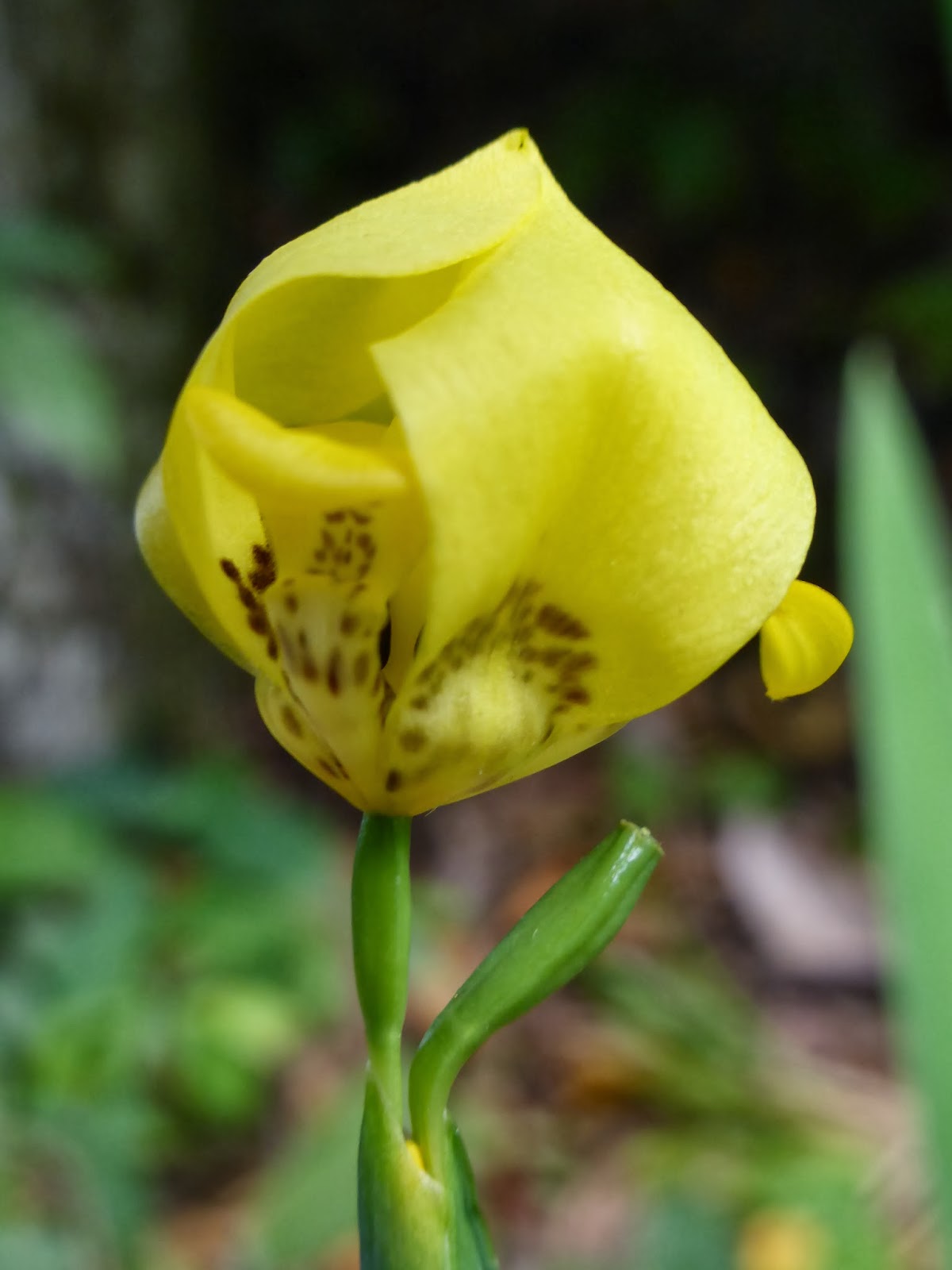
| An unopened flower of Yellow Walking Iris |
Showing posts with label nature. Show all posts
Showing posts with label nature. Show all posts
Monday, March 10, 2014


Saturday, December 22, 2012
Millipede
 |
| Millipede © Denise Etienne |
Yesterday I was weeding my
garden and came upon an interesting pair of Millipedes. Perhaps they were
mating?
Millipedes do not bite and
are harmless to humans. Usually they are found in damp or moist areas.The word
Millipede means 1000 legs, but in reality they have a lot less. In fact, the
more common ones usually have 200 to 400 legs on average, having two pairs of
legs per body segment.
Their diet consists mainly
of decaying plant matter, such as leaves, wood and rarely ever green leaves.
Tuesday, April 24, 2012
Naturalist Notes: Update/Correction - Tobacco Hornworm Caterpillar
In my last post I thought
I had a Tomato Hornworm Caterpillar on my Tomato plant. However, after doing
some more research I discovered in fact that it is actually a Tobacco Hornworm Caterpillar. They are very similar in appearances. One of the major differences
between the two Caterpillars are along their bodies; the Tobacco Hornworm has 7 diagonal lines,
while the Tomato Hornworm has 8 lateral “V” formations. In addition, the
“horn-like tail” is pink in the Tobacco and black in the Tomato Caterpillar. Both plants,
Tobacco and Tomato belong to the Solanaceae family.

© Denise Etienne
Wednesday, August 17, 2011
Naturalist Notes: In the Backyard
There is always something interesting happening in nature. Some people have this misconception that you have to be in the forest to see the wonders of nature, but really nature exists all around us! Just take a moment and look around, do you know how much cool stuff you can discover right in your own back yard?
Today I looked out my back door and there were Tropical Mockingbirds, Palm and Blue Tanagers, House Wrens, Yellow Orioles, and Bare-eyed Thrushes.
So next time you’re outdoors tune in to your surroundings, you would be surprise as to the amount of wildlife that exists.
__________________
Standing upright and tall
With strong arms wide open
In each and every direction
Teeming with life
And yet giving life to all
Who am I?
© Denise Etienne
Wednesday, August 3, 2011
Naturalist Notes: Black Vulture
The Black Vulture is relatively smaller than the Turkey Vulture. It is mainly black, except for the wing tips (fingers) which are whitish in color and very distinctive, especially in flight. Their heads are also featherless and black in color.
Besides feeding on carrion and occasional fruits, they are sometimes known to attack live prey, particularly newborns like the hatchlings of Leatherback turtles as they emerge from the sand. This species is more often observed in large groups.
© Denise Etienne
Wednesday, July 20, 2011
Naturalist Notes: Zone-tailed Hawk
Lately I have been seeing quite a number of Zone-tailed hawks as I walk throughout Arima and Malabar. This species of raptor (bird of prey) is mainly black and is sometimes confused with the Turkey Vulture, because they share several similarities.
They both have a dihedral shape when they fly, which simply means they hold their wings above their bodies in a V formation. When viewing both in flight, the underpart of the wings are two toned in color, the upper half darker than the lower half. In addition, they are both unsteady flyers, rocking back and forth.
They both have a dihedral shape when they fly, which simply means they hold their wings above their bodies in a V formation. When viewing both in flight, the underpart of the wings are two toned in color, the upper half darker than the lower half. In addition, they are both unsteady flyers, rocking back and forth.
The main distinguishing feature I use in identifying them is their tail, the Zone-tailed has at least 2 white stripes on the tail, also the edge looks like it has been clipped with scissors — it appears almost squared, as opposed to the Turkey Vulture's tail which lacks the white stripes and is rounded at the edge.
A major difference between both birds is their diet, the Zone-tailed feeds live prey like mammals and birds, while the Turkey Vulture feeds on carrion. It is also smaller in size than the Turkey Vulture. Once you are close enough to the Turkey Vulture you should be able to see their red featherless head, whereas the Zone-tailed head is covered with feathers.
A major difference between both birds is their diet, the Zone-tailed feeds live prey like mammals and birds, while the Turkey Vulture feeds on carrion. It is also smaller in size than the Turkey Vulture. Once you are close enough to the Turkey Vulture you should be able to see their red featherless head, whereas the Zone-tailed head is covered with feathers.
An interesting fact is that sometimes you can find a Zone-tailed hawk flying amongst a group of Turkey Vultures, it is believe they do this to capture unsuspecting prey! So next time you see a Turkey Vulture look closer it might just be a Zone-tailed hawk.
© Denise Etienne
Wednesday, June 15, 2011
Feel
Close your eyes and listen to the wind.
As it dances through the leaves.
Filling your heart with utmost joy, in its simplicity.
Feel it caressing your skin.
Comforting, counseling and healing your soul.
© Denise Etienne
Wednesday, June 8, 2011
Naturalist Notes: White-Chested Emerald Hummingbird
One of the most aggressive species of hummingbird I have encountered while birding in the rainforest is the White-Chested Emerald. They intensely defend their territory by chasing away other birds, even people at times. They are indeed fierce! It is not recorded in Tobago.
This is a monomorphic species, which means the sexes are similar in appearance. They are just about 3.75 inches in length. Their upperparts are mainly green fading into a bronze rump and tail, (from the back it looks very similar to the Copper-rumped hummingbird, but lacks their distinct blue tail). The underparts are white with greenish sides. This species is quite vocal with no particular tune.
So folks, this wraps-up the 17 hummingbirds of Trinidad. I hope you all enjoyed, please feel free to ask any questions!
© Denise Etienne
Wednesday, June 1, 2011
Naturalist Notes: Long-billed Starthroat Hummingbird
I have seen the Long-billed Starthroat hummingbird mostly in forested areas in Trinidad. It is not recorded in Tobago.
This infrequent species is just about 4.5 inches in length. The sexes are generally bronze-green in color on the upperside and grayish on the underside, both have white moustachial streaks. The males have a distinctive turquoise crown with a reddish throat, while the females have a greenish crown with a black throat. When identifying this species I particularly look for a white jagged streak on the back, this is not usually noted in the field guides.
Their straight bill is reminiscent of a sword because it’s so long!
© Denise Etienne
Thursday, May 26, 2011
Naturalist Notes: Brown Violetear Hummingbird
The Brown Violetear hummingbird spends most of its time in the mountainous rainforests of Trinidad. It is not recorded for Tobago.
This species is just about 4.75 inches in length. It is mainly seen feeding in the canopy on Immortelle flowers and occasional epiphytes, though I have also seen them on hummingbird feeders. The sexes are very similar in appearance, mostly brown above and gray below with a violet patch on the ear-coverts, and a sparkling green and blue throat stripe.
I have observed this species several times during the months of December through March at the Asa Wright Nature Center, which is just about 1200 ft, other times of the year it is found at higher elevations over 2500ft.
© Denise Etienne
Wednesday, May 18, 2011
Naturalist Notes: Blue-tailed Emerald Hummingbird
The Blue-tailed Emerald is yet another species that is not found in the rainforest and is considered somewhat uncommon. It spends most of its time in semi-open savannah and scrub areas. It is not recorded in Tobago.
This species is just about 3 inches in length. The sexes are similar, both are overall green in color with white thigh feathers and a forked blue tail. The female also has a blackish ear-patch.
This species is one that I am yet to see in person, according to its description it is very similar to the Blue-chinned Sapphire, which is my favorite hummingbird.
© Denise Etienne
Tuesday, May 10, 2011
Naturalist Notes: White-tailed Goldenthroat Hummingbird
In keeping with hummingbird species that are hardly ever found in the rainforest, and somewhat uncommon, the White-tailed Goldenthroat is a perfect example. It mostly frequents marshy savannahs or open grassy areas near water. It is not recorded for Tobago.
This species is just about 4 inches in length, both sexes are mainly green in color with a slightly decurved bill and facial streaks (above and below their eyes). The male streaks are white, with a sparkling green throat and white outer tail feathers. The female streaks and stomach is rufous in color. This particular species is one that I am yet to see in person.
© Denise Etienne
Wednesday, May 4, 2011
Naturalist Notes: Green-throated Mango Hummingbird
The Green-throated Mango Hummingbird is usually found in mangrove swamps especially in Caroni. I have spent most of my birding years in the rainforest habitat of Trinidad, making occasional trips to other habitats on the island. Hence, I have only gotten mere glimpses of this species.
It is just about 5 inches in length. The male Green-throated mango is overall green in color, with a black line on his chest, and a purple tail. The female of this species is very similar to the Black-throated Mango, I read it’s hard to tell them apart.
This is one species that I have hardly ever seen perched.
© Denise Etienne
Wednesday, April 27, 2011
Naturalist Notes: Black-throated Mango Hummingbird
The Black-throated Mango Hummingbird can be found in both Trinidad and Tobago. It is just about 4.5 inches in length. It is a dimorphic species, where the appearance of the sexes varies. The male has bright green upperparts, his throat and chest are black, bordered with blue-green, and has a purple tail. The female has bronze-green upperparts, while her throat and chest white with a prominent black central stripe, and has a reddish tail.
This species is fairly common on both islands. Frequently seen feeding on flowers of Immortelle, Poui, and Hibiscus. In the rainy season especially I have observed them hawking for insects, in particular rain flies (a.k.a. termites).
Also, just a note, the female Black-throated Mango Hummingbird is exquisitely painted by Beatrice Bork, and is the Cover girl for our book “Birds of Trinidad”.
© Denise Etienne
Wednesday, April 20, 2011
Naturalist Notes: Little Hermit Hummingbird
The Little Hermit Hummingbird is the smallest in the group of Hermits found in Trinidad, it’s not recorded in Tobago. It is about 4 inches in length, the upperparts are mainly bronze-green, and the underpants brownish in color.
This species is in same genus as the Green Hermit, hence they are similar in shape. Both have a long and decurved bill, with elongated central tail feathers. They are also known to form communal leks to attract the females.
Some of their favorite flowers are Shrimp plant, Lipstick plant and a variety of Gingers.
From my many years experience as a naturalist, of the three species of Hermits, the Little Hermit is the least frequently seen in the rainforest.
© Denise Etienne
Sunday, April 17, 2011
Our book “Birds of Trinidad”

For the last few years I have been collaborating with an extremely talented artist, Beatrice Bork. We have been working on compiling a book, with both her watercolor paintings and my poetry. Beatrice first came to Trinidad via the Don Eckelberry Award for her achievements in bird art.
I am happy to announce that the book is finally completed! We both feel a great sense of accomplishment. To all those who have been supportive, thank you!
If you are interested in purchasing a copy of our book please click here
D
Wednesday, April 13, 2011
Naturalist Notes: Rufous-breasted Hermit Hummingbird
This Hermit has a brown head, while the rest of the upperparts are mainly greenish, and the underpants mainly rufous in color. They also have a rounded tail with a white band on the edge, unlike the Green Hermit that has long central tail feathers.
One of their favorite flowering plants is Heliconias. They are well adapted to pollinating the flower because of their long and decurve bills.
Early one morning I took a walk out to the “Clear water pool” at the Asa Wright Nature Center, just over the water on the bank was a Fern plant. There, I got a glimpse of a female Rufous-breasted Hermit as she was constructing her nest on one of the hanging leaves, and I thought how lucky I was to see this little miracle of nature!
© Denise Etienne
Thursday, April 7, 2011
Naturalist Notes: Green Hermit Hummingbird
The largest hummingbird in Trinidad is the Green Hermit. It measures 6.5 inches in length, it’s actually larger than the Ferruginous Pygmy Owl! This hummingbird is mainly green in color. They have a rather long and decurved bill, as well as long and tapered tail feathers that's white-tipped.
The Green Hermit hummingbird spends most of its time in the undergrowth, feeding on flowers like Heliconias and Gingers, they are also known to take insects. Occasionally they do visit hummingbird feeders but don’t hang around for a long time.
A few years ago I was out on a Christmas Bird Count in La Laja, and we were lucky enough to stumble upon a “Lek”. A Lek is a gathering of males species, for the purposes of competitive courtship.
© Denise Etienne
Monday, April 4, 2011
“Reflections”
 | |||||||||||||||||||||||||||||||||||||||||||||||||||||||||||||||
|
Wednesday, March 30, 2011
Naturalist Notes: Rufous-shafted Woodstar hummingbird
The Rufous-shafted Woodstar hummingbird is one of the smallest birds in Trinidad. It measures just 2.75 inches in length, similar in size to the Tufted Coquette.
This species is extremely rare. In the past I have only seen them the in dry season at Asa Wright Nature Center, during the months of March through May. They hardly ever visit the hummingbird feeders, spending most of their time in the forest feeding on flowers. It is indeed one of the shyest species of hummingbirds and very little is known about them. Like the Tufted Coquette it is often times confused with a large Bee!
© Denise Etienne
Subscribe to:
Posts (Atom)